
Project 2: Anatomy of Letterforms
“It is important to use your hands, this is what distinguishes you from a cow or a computer operator.” – Paul Rand
Description:
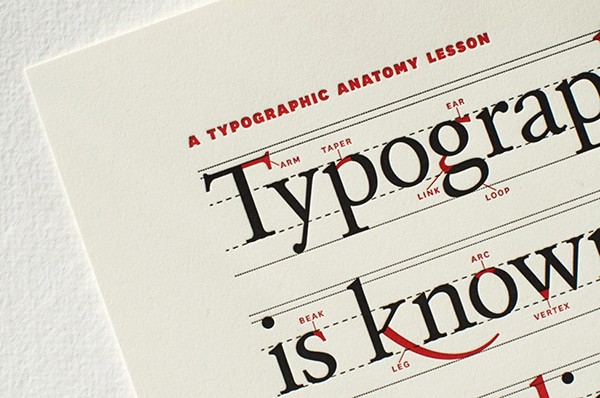
The understanding of typographic terminology is critical to further effectiveness as a typographer and graphic designer. In this assignment you will become familiar with and explore the unique characteristics of the major classification in typographic design.
Using a grid and a given set of letterforms, you will enlarge and translate (through hand rendering) letterforms from the 5 major classifications: Old Style (Garamond), Transitional (Baskerville), Modern (Bodoni), Egyptian (Clarendon), San Serif (Univers). You are required not to use any mechanical instruments/devises while constructing the letterforms (you may use your T-square and triangle to create the enlargement grid).
You must complete three uppercase and three lowercase letterforms. It is important to take note of various subtleties and nuances found within all typographic design and construction.
Objectives:
To comprehend and explore the anatomy of letterforms, typeface variations, and typeface identification while mastering skills in sketching and craft.
Process:
+ The student will be given a packet of letterforms.
+ Read and analyze “Typographic Design: Form and Communication,”
Chapter 2: The Anatomy of Typography.
+ Identify which classification your letterforms belong to.
+ Re-construct (by hand) the grid of your letterforms at 200% of the
original size using your blue Repro pencils onto your 18″ x 24″ drawing paper.
+ Enlarge (by drawing) each letterform at 200% of their original size
using your pencils. (6 letterforms).
DOWNLOAD:
GD1_Project2_Fall 2024
Typography for Design: Five Classic Typefaces
14x20InchGrid_Letterforms
Grid Structure
Recent Posts


Leave a Reply