
Project 4: Typographic Syntax
Project Inspiration:
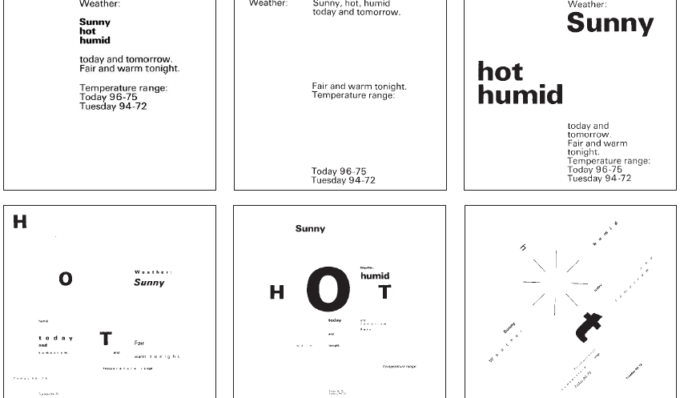
Dan Friedman’s Weather Report (student exercise at Yale, 1970-71)
“The goal of legibility is to optimize communication by making the message orderly, simple, static, even banal. This mode assumed the reader to be a relatively passive recipient. On the other hand, readability engages disorder, complexity, dynamism, originality (and I would add, wit), conditions that promote interest, pleasure, and a more active reader participation.” – Dan Friedman/Design Observer
“Syntax is the connecting of typographic signs to form words and sentences on a page. The elements of design — letter, word, line, column, and margin — are made into a cohesive whole through the use of typographic space, visual hierarchy, ABA form, and grid systems.” —-Carter, Day, Meggs
Objectives
+ To investigate the concept of visual hierarchy and its related properties such as space, visual punctuation, contrast, balance, rhythm, texture, and visual compensation.
+ To understand how visual hierarchy is achieved through the alteration, manipulation, and orientation of typographic elements and how these elements relate not only to one another but to the whole.
+ To apply concepts like the effects of letter spacing, leading, typographic size, weight, scale, word spacing, orientation, grouping, spatial relationship to the communication of a message and guide the reader’s eye through a specific and considerate typographic arrangement.
+ To understand the function of the grid as an element of design.
+ To translate these concepts into a pragmatic, concrete form.
Process
You will design a series of five 8″x8″ frames and one 11″x17″ poster of typographic variations using the following criteria:
+ The type family that will be used for this project is AVENIR.
+ Think of creating variation through in terms of negative space, leading, tracking and kerning.
Variation 1
Use only one font (one point size and type weight). The leading must remain constant in this variation. After you have chosen a point size to work with, determine the basic amount of leading you want to use. For example, if you choose type that is 10 points, your leading may be 12 points (10/12). In order to achieve a variation of spatial intervals, you may set your type using one unit of leading (for example 12) or any multiple of that unit (i.e 24pt., 36pt.). Choose one orientation on the page (horizontal, vertical, or diagonal) for this variation. B&W
Variation 2
One point size / two different type weights / one leading / one orientation / B&W
Variation 3
Two different point sizes / three different weights / one leading / different orientations / B&W
Variation 4
Different point sizes / different type weights / different leadings / different orientations / B&W
Variation 5
Same as Variation 4 + Typographic Punctuation (ie: rules, boxes/containers, bullets, etc) / B&W
Variation 6
Same as Variation 5 + Self-Produced Image (photo or illustration)
One in B&W/ One in Color for 11″ x 17″ (see below final project)
In each variation, the copy does not have to be placed in the order given. YOU DEFINE THE HIERARCHY! Determine what is important to the message, what needs to be communicated, and what becomes secondary information. Investigate the space of the entire page.
Each one of these variations must be done in order. The next variation can not be started until the sketches for the previous one are completed and approved. What you accomplish in each variation should build upon the experience attained from your previous projects.
Remember! Everything must have a purpose. You must be able to verbally justify everything you manipulate. Nothing should be done randomly or without a good reason.
+ Letraset Studio Tac is a mounting adhesive that does not leave any residue on the board. To purchase: https://www.dickblick.com/products/grafix-artist-tac/
Final Presentation
Variations 1- 6: digitally produced design layouts in InDesign printed and mounted onto a white, 8″x8″ matte board (no borders). Please print variation design decisions and adhere to the back. Should include variation number and details.
Variation 6: 11×17 Color Poster printed and mounted onto a white, 11″x17″ matte board. (i.e point size, different weights, tracking/leading decisions)
Copy:
See Project 4 pdf (below)
Timeline:
Monday, November 20: Reading: The Grid, Ideation, Begin Sketching
Monday, November 27: Sketches, Show Grid and Variation Notes
Wednesday, November 29: One-on-One work
Monday, December 4: Peer Critique, Begin Scanning and Digitizing
Wednesday, December 6: Individual Critiques
Monday, December 11: Individual Critiques
Wednesday, December 13: Exam Review, Project 4 due
Monday, December 18: Final Exam
(Tested on Readings/Coursework/Journal)
Recent Posts


Leave a Reply